
Hands-on care, closer to home
In-Home Nurse Practitioner Visits in Northern Virginia
Some healthcare needs are better handled in person, but getting to a clinic is not always practical. Eligible home visits bring selected outpatient assessment and care to patients in Northern Virginia.
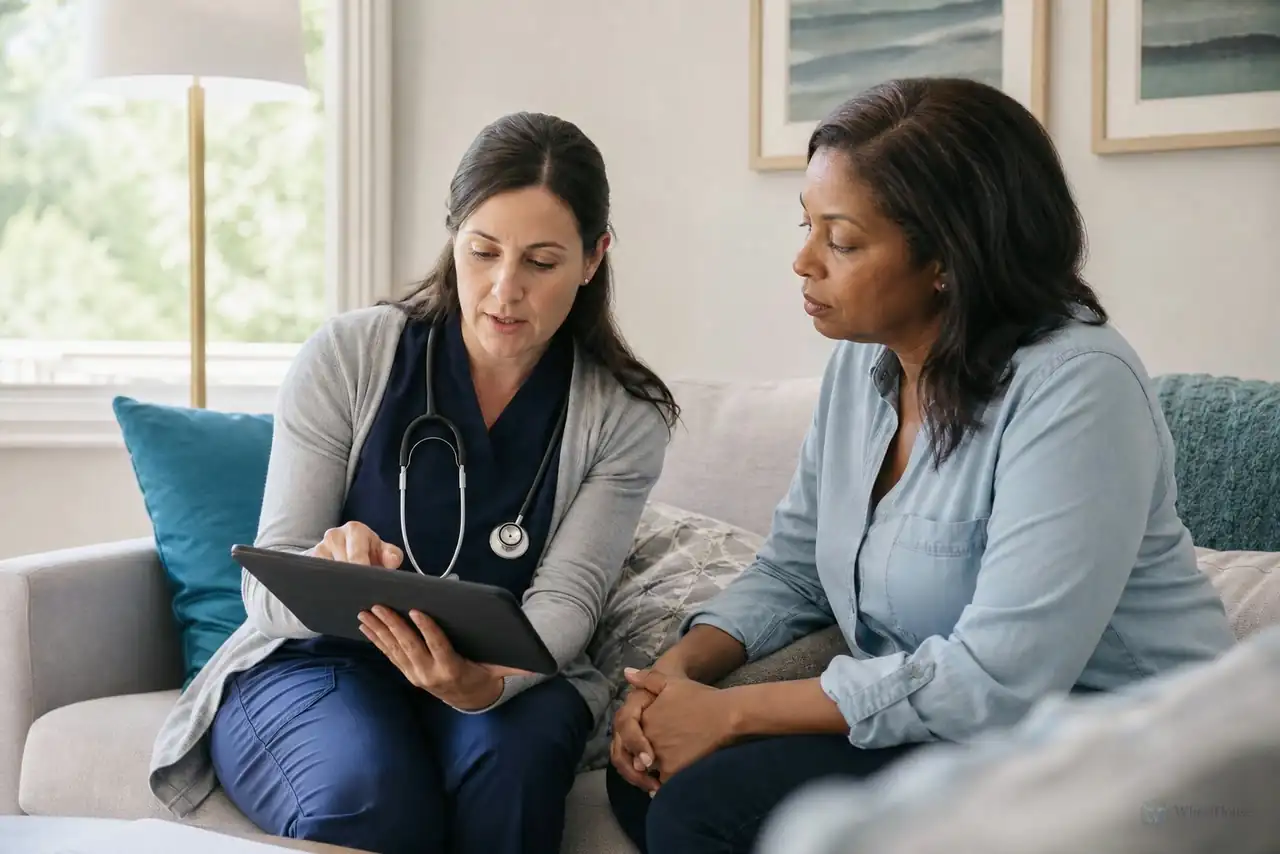
What a visit can include
A focused, in-person assessment in your setting.
- ✓Physical examination based on the reason for the visit
- ✓Vital signs and other clinically relevant observations
- ✓Medication, symptom, and available-record review
- ✓Home-environment observations for selected safety or health needs
- ✓Wound assessment and selected wound-care services
- ✓Caregiver education and follow-up instructions
- ✓Planning for virtual follow-up, outside testing, referral, urgent care, or emergency evaluation
Who may benefit
Useful when mobility, transportation, or hands-on needs make travel harder.
Home-based visits may help patients with mobility or transportation limitations, patients needing wound or skin assessment, older adults who benefit from evaluation in their living environment, and eligible residents of assisted- or independent-living settings.
A home visit may also be appropriate when a virtual visit identifies a need for hands-on assessment and the necessary care can be provided safely at home.
Service area
Focused in Northern Virginia.
Coverage is focused in Northern Virginia and varies by address, visit type, clinical need, clinician schedule, and whether the requested care can be provided safely in the home. Share your ZIP code and general visit type so current eligibility can be confirmed.
The right setting
Home visits are for stable outpatient needs.
Some problems require a clinic, imaging facility, emergency department, hospital, or specialist because the necessary equipment or treatment is not available in the home.
Common questions
In-Home Nurse Practitioner Visits FAQs
Clear answers before you decide what kind of care you need.
Do I need to be a member?
Home-visit access and pricing vary by current membership tier and visit type. Confirm the current terms when requesting care.
Can you visit assisted-living communities?
Selected on-site services may be available at eligible assisted- and independent-living communities in the Northern Virginia service area.
Can lab work be performed at home?
Selected testing may be possible depending on the visit and current capabilities. Other labs require an outside laboratory or another setting.
Can a home visit replace urgent care?
Not always. Home visits are for eligible, stable outpatient needs. Symptoms needing immediate testing, imaging, procedures, or emergency treatment need a properly equipped setting.
How do I know whether my address is covered?
Contact WheelHouse Health with the ZIP code and general visit type. The team can confirm current geographic eligibility before scheduling.
Complete care guide
Selected in-home Nurse Practitioner visits in Northern Virginia
A home visit can reduce travel and add useful context when a stable outpatient need requires hands-on assessment. Availability depends on the address, clinical concern, environment, resources, clinician authorization, and whether care can be provided safely outside a facility.
Use the contents list to move directly to the question or decision that matters to you.



Hands-on care with less travel
The benefit of a home visit is not the location alone, it is the information the setting can provide.
Travel can be a real barrier when a patient has limited mobility, depends on a caregiver, uses medical equipment, is recovering, or needs repeated wound follow-up. A home visit may reduce that friction while allowing selected direct examination and observation. It can also show how the patient moves through the space, stores medications, uses supplies, and manages the plan between appointments.
That context can make recommendations more realistic. A mobility suggestion may need to account for stairs or narrow pathways. A medication plan may be affected by duplicate bottles, packaging, vision, or caregiver roles. Wound support may depend on the available surface, lighting, supplies, pressure-management equipment, and the person performing care. These observations do not replace necessary facility-based testing, but they can reveal barriers that a clinic visit may not show.
WheelHouse Health may provide selected in-home outpatient services for eligible Northern Virginia patients. The service is not automatic for a diagnosis, membership, or ZIP code. The practice must confirm the location, visit type, patient stability, clinician schedule, environment, and whether the needed assessment or treatment can be delivered safely with the resources available.
Potential fit
Home-based care may fit when hands-on information is needed and travel is disproportionately difficult.
Patients who have mobility or transportation limitations may benefit from evaluation at home when the clinical need is stable and appropriate for outpatient care. Selected wound or skin concerns, medication reconciliation, follow-up after a virtual visit, assessment of functional context, and caregiver education may also be reasons to ask about availability. Residents of assisted- or independent-living communities may be eligible when the location permits outside clinicians and the requested service fits.
A patient does not need to prove that leaving home is impossible simply to ask. The practical question is whether the home setting improves access without removing resources the visit requires. In some situations, a clinic is more efficient because testing, equipment, staff support, or procedures are available there. In others, the home reveals information that materially improves the plan.
Eligibility is confirmed case by case. Age alone, disability, membership tier, a prior home visit, or residence in Northern Virginia does not guarantee service. The clinician may first recommend telehealth to clarify the request, or may direct the patient to a clinic, laboratory, imaging center, urgent care, emergency department, or specialist when the home is not the right setting.
Travel time and arrival windows may differ from a clinic appointment, so confirm how the practice communicates delays and what happens if the patient is unavailable, the building cannot be entered, or the environment is not safe for care. Ask about cancellation and rescheduling before the visit. Do not publish access codes or detailed living information in a public message; use the approved administrative route for logistics and the designated patient system for clinical information.
If the patient lives in a facility, ask who must approve entry and whether staff need advance notice. Clarify whether WheelHouse is being asked to provide a separate outpatient visit or coordinate with an existing care team. Duplicate or conflicting plans can create risk, so bring the current facility medication record and recent instructions when the practice requests them.
- Mobility or transportation barriers
- Selected stable needs that require direct observation or examination
- Caregiver teaching connected to an assessed plan
- Home context that may affect safety or follow-through
A focused outpatient encounter
The visit is shaped by the reason for care, not by a standard home checklist.
A home appointment may include a focused history, medication and allergy review, selected vital signs, direct examination relevant to the concern, review of available records, and observation of factors in the environment. Wound visits may include measurements, surrounding-skin assessment, review of current supplies, and caregiver education when clinically appropriate. The exact activities depend on the clinician’s scope, the patient, and the resources brought to the visit.
The clinician may identify a need for outside testing, imaging, a prescription decision, virtual follow-up, another hands-on visit, or referral. A home visit does not guarantee a procedure, laboratory collection, debridement, medication, refill, form completion, or certification. Some tasks require advance records, specific equipment, facility authorization, or a different professional.
Before scheduling, describe the general visit type through the administrative channel and complete the detailed clinical intake only through the designated system. Ask whether the service you need can be considered at home and what information must be available. Clear expectations reduce the chance that a visit arrives without the equipment, records, consent, or setting needed to answer the clinical question.
A home appointment should have a defined clinical question and a realistic plan for anything that requires outside testing, equipment, or emergency resources.
Set up for privacy and safety
A simple, well-lit care area helps the visit focus on the patient.
Follow the practice’s preparation instructions. Choose an area with adequate light, a stable chair or bed when relevant, and enough clear space for the clinician to work without unsafe lifting or reaching. Secure pets before arrival, minimize smoke and interruptions, and let the practice know in advance about building access, stairs, parking restrictions, gate codes, facility check-in, or other logistical barriers.
Protect privacy by deciding who should be present. A family member or caregiver can help with history, medication review, translation arrangements, mobility, or learning the plan, but the patient may also need time to speak privately. Do not assume that residence staff or relatives may automatically receive health information. The clinician must follow the patient’s choices and applicable privacy rules.
Gather current medications in their original containers when asked, allergy information, relevant records, discharge instructions, current supplies, and requested home readings. Do not dispose of medications, remove a wound dressing, fast, change treatment, or perform a procedure solely to prepare unless the practice gives specific instructions. Keep emergency contact information available and tell the team if the patient’s condition changes before arrival.
- Clear entry and a safe, well-lit care space
- Pets secured and smoke or interruptions minimized
- Medication containers, records, supplies, and requested readings ready
- Consent and privacy expectations discussed with caregivers or facility staff
Shared roles
Caregiver involvement should support the patient without replacing consent or clinical responsibility.
A caregiver can contribute a timeline, describe changes, show how a task is being performed, and learn the follow-up plan. The patient should remain involved to the extent they are able and should identify who may participate. If another person has legal authority to make healthcare decisions, the practice may need documentation. Scheduling an appointment for someone does not automatically authorize disclosure of that person’s health information.
When teaching is appropriate, ask the caregiver to repeat back key steps or warning signs. Tell the clinician about limitations in strength, vision, hand function, understanding, time, or access to supplies. A plan that depends on a caregiver doing something they cannot safely perform needs to be changed. Caregivers should not be expected to carry out clinical procedures beyond their training and authorization.
Assisted- and independent-living communities may have visitor rules, preferred vendors, documentation requirements, medication policies, and limits on where care can occur. WheelHouse Health must confirm that the setting permits the service and that roles are clear. A home visit from an outside practice does not replace facility nursing, emergency response, or services the residence is legally responsible to provide.
What the environment can reveal
Use observations to make the plan practical, not to judge the household.
The home may reveal medication duplication, difficult stairs, limited food storage, trip hazards, inaccessible bathrooms, pressure points in a chair or bed, inadequate lighting, or supply problems. These observations are useful when they connect directly to the health concern and patient goals. They should be discussed respectfully, with attention to privacy, culture, finances, housing constraints, and what changes are realistically possible.
A clinician may suggest follow-up with primary care, therapy, social services, equipment providers, pharmacy, nutrition support, home health, or another resource. A WheelHouse home visit is not automatically the same as Medicare-certified home health, skilled nursing, personal care, emergency medical services, or continuous monitoring. Each service has different eligibility, staffing, payment, and regulatory requirements.
Patients and families should ask what WheelHouse will do, what another service must do, and who will arrange each step. The practice cannot guarantee that an outside agency accepts a referral, participates with insurance, has immediate availability, or can provide a particular benefit. The visit can still help by naming the gap clearly and documenting why another resource may be needed.
The right level of care
A house is not a substitute for a facility with emergency, imaging, or procedural resources.
Home visits are intended for eligible, stable outpatient needs. The clinician arrives with resources appropriate to the planned service, not with the full capabilities of an emergency department, hospital, imaging center, laboratory, or specialty clinic. Unexpected findings may require the visit to stop and the patient to use another setting.
Do not request a routine home appointment for a possible emergency. Call 911 for chest pain, serious trouble breathing, stroke-like symptoms, severe injury, uncontrolled bleeding, loss of consciousness, or another potentially life-threatening concern. Severe or rapidly worsening symptoms may need urgent assessment even when they are not captured by a brief list. Routine scheduling, email, and portal messages are not emergency-response services.
If the patient’s condition changes between booking and arrival, contact the practice through the instructed route, but do not delay emergency care while waiting for a response. Building rules, distance, traffic, schedule, or membership status should never be used as a reason to wait when immediate evaluation is needed. A home visit can support access only when it remains the clinically appropriate level of care.
For a possible emergency, call 911 or seek immediate emergency care. A scheduled home visit cannot provide emergency response.
Availability and terms
Confirm the address, visit type, cost, and written plan rules before relying on access.
WheelHouse Health describes selected home-based care focused in Northern Virginia. Actual coverage varies by address, travel practicality, facility permission, clinician location and authorization, clinical need, visit length, supplies, and current schedule. A county name or ZIP code on a marketing page should not be treated as a guarantee that every address or service is covered.
Ask for the current cost and what it includes. A home visit may be direct-pay, included under specific membership terms, or subject to an additional charge. Outside supplies, laboratory services, imaging, pharmacy costs, specialists, equipment, or facility fees may be separate. Membership is not health insurance and does not replace coverage for emergency, hospital, specialty, or other outside care.
If home access is important to a membership decision, locate the exact benefit in the plan-specific written enrollment agreement. Confirm visit limits, geography, clinical eligibility, scheduling, added charges, cancellation, and what happens when home care is unavailable or inappropriate. Public plan cards are summaries; the current written agreement presented before enrollment controls the plan terms.
Follow-through at home
Leave with instructions, ownership, and a route for questions.
Before the clinician leaves, ask what the working plan is, what remains uncertain, which changes should prompt earlier assessment, and who is responsible for each next step. Review medication directions, wound or monitoring instructions, outside orders, referrals, and follow-up timing. If a caregiver will carry out part of the plan, make sure that person understands the expected task and can perform it safely.
Written instructions and clinical communication should use the designated patient system. Do not send symptoms, images, medication lists, or records through ordinary email or public contact channels. Ask how an outside result will return to the practice and whether a virtual or hands-on follow-up is expected. A referral or order is not complete simply because it was discussed; confirm the receiving service and next action.
To request a visit, share the ZIP code or address through the approved administrative process and describe the general service type without unnecessary clinical detail. The practice can then confirm geographic and service eligibility and provide clinical intake instructions. For a possible emergency, call 911 rather than waiting for a home-visit decision or routine message response.
Confirm current availability for the location and general visit type, then provide medical details only through the designated clinical system.
Start here