
Care from wherever you are
Telehealth & Virtual Primary Care in Virginia
Secure virtual primary care can be a convenient starting point for many non-emergency concerns, follow-up visits, medication questions, chronic-condition management, lab review, and preventive planning.
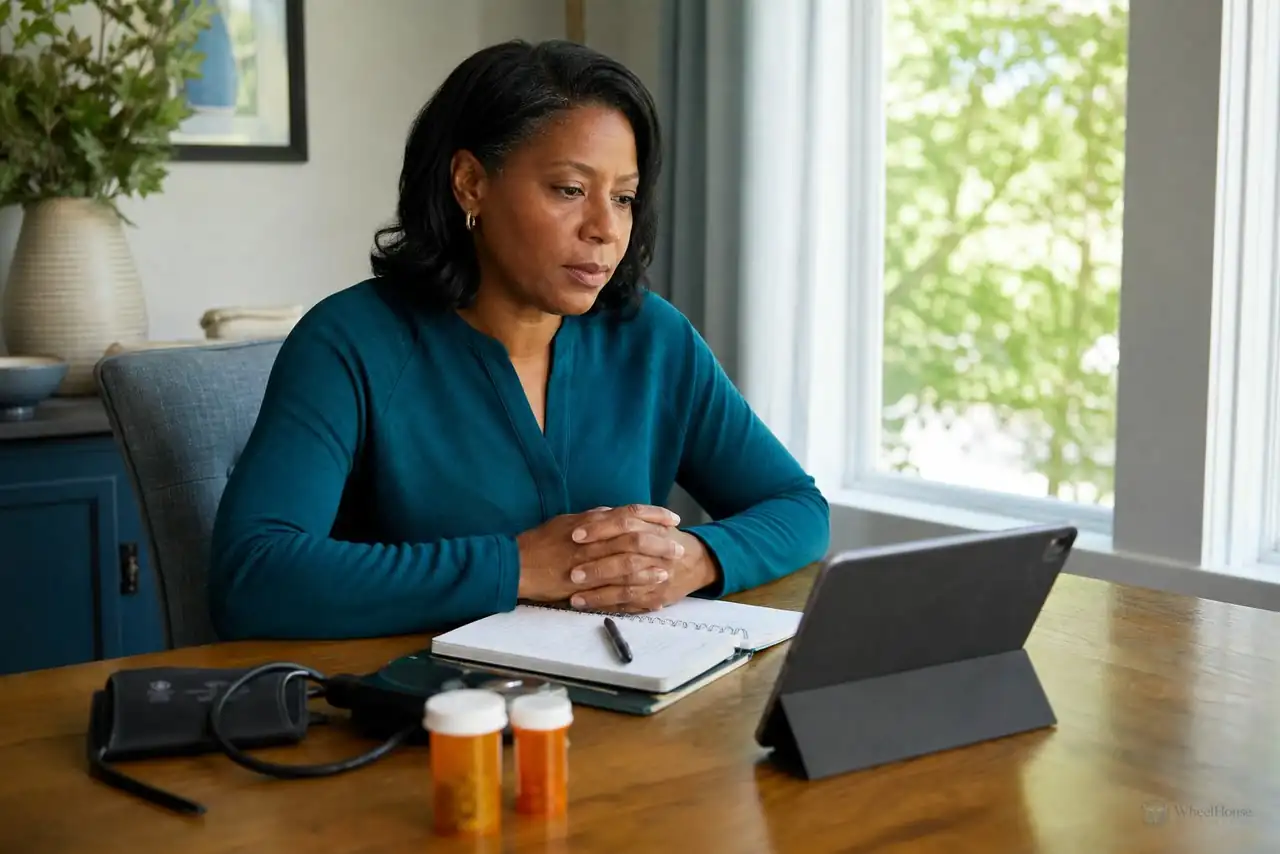
What telehealth can help with
Many primary-care needs can begin at home.
Virtual care works best when the clinician can make a safe decision from your history, visible findings, available home measurements, records, and follow-up information.
- ✓Selected common illness symptoms and minor urinary concerns
- ✓Medication review, refill requests, and side-effect discussions
- ✓Stable chronic-condition follow-up and home-reading review
- ✓Lab and test-result discussions
- ✓Preventive care, nutrition, and lifestyle planning
- ✓Selected visible skin concerns and post-treatment check-ins
Good to know
Some symptoms that sound routine still require testing or an in-person examination.
Your visit
A virtual appointment is still a clinical evaluation.
02
Discuss
Explain when the concern started, what changed, what you tried, and what decision you need.
03
Assess
Review symptoms, visible findings, readings, results, and medication safety with your clinician.
04
Plan
Leave with next steps that may include treatment, monitoring, testing, in-person care, or referral.
Prescriptions
Can a telehealth Nurse Practitioner prescribe medication in Virginia?
Eligible prescriptions may be sent electronically when the medication is clinically appropriate and prescribing through telehealth is permitted by applicable law. A telehealth appointment does not automatically result in a prescription.
Some medications or clinical situations require an in-person examination, additional records, testing, ongoing monitoring, or care from another clinician.
When in-person is better
Telehealth is one setting, not every setting.
An in-person evaluation may be more appropriate when the clinician needs to perform a hands-on examination, obtain reliable vital signs, collect a specimen, perform point-of-care testing, assess a wound in detail, or complete a procedure.
When a concern falls outside the practice’s scope or needs faster or more specialized evaluation, you will be directed to an appropriate urgent-care center, emergency department, laboratory, imaging center, or specialist.
Common questions
Telehealth & Virtual Primary Care in Virginia FAQs
Clear answers before you decide what kind of care you need.
Is telehealth secure?
WheelHouse Health uses designated secure patient and telehealth systems for clinical visits and protected health information. Use official practice links and choose a private setting whenever possible.
Can telehealth replace all primary-care visits?
No. Physical examinations, procedures, testing, imaging, certain medication requirements, and urgent symptoms may require in-person care.
Can I send a photo of a rash or wound?
Use only the secure method provided by WheelHouse Health. A photo can support assessment, but it does not always replace a hands-on examination.
How quickly can I be seen?
Availability varies by schedule and membership level. Check the current booking system. Do not wait for a routine appointment if symptoms are severe or rapidly worsening.
Can WheelHouse Health refill my medication?
Refill requests can be reviewed. Approval depends on the medication, diagnosis, recent monitoring, clinical history, and whether an in-person evaluation or testing is required.
Complete care guide
Telehealth and virtual primary care for eligible Virginia patients
A virtual appointment can be a convenient clinical starting point when the history, visible information, records, and available home readings are enough to support a safe decision. The value is knowing both what telehealth can do and when another setting is better.
Use the contents list to move directly to the question or decision that matters to you.


A real visit in a different setting
Telehealth is a clinical encounter, not an online answer generator.
A telehealth visit uses live electronic communication to bring patient and clinician together while they are in different locations. It can support history-taking, medication review, discussion of results, observation, selected guided movements, review of reliable home measurements, and care planning. The clinician still has to gather enough information to make an appropriate decision and document the encounter.
The format does not lower the standard of care. If the available information is incomplete or a physical finding could change the plan, the visit may lead to a direct examination, testing, imaging, referral, urgent care, or emergency care. That redirection is a normal part of good telehealth, not a failure of the technology or the patient.
WheelHouse Health confirms telehealth availability according to the patient’s physical location at the time of the visit, clinician authorization, identity, consent, clinical need, technology, and current schedule. A mailing address or prior visit is not enough to establish eligibility for every future encounter. The patient should be prepared to state where they are physically located and how they can obtain local help if the situation changes.
Sources and further reading
Appropriate uses
Virtual care works best when the key evidence can travel through the screen.
Selected non-emergency concerns can begin by telehealth when the patient can describe a clear history and the clinician can safely rely on conversation, visible findings, available records, and requested home data. Common reasons for a virtual primary-care appointment include a medication question, review of stable home-reading trends, discussion of a laboratory report, preventive planning, follow-up after prior evaluation, or a selected visible skin concern.
The label of a symptom does not determine the setting by itself. Two people with the same general complaint may need different care because of severity, associated symptoms, age, pregnancy, medical history, medications, immune status, recent procedures, or how quickly the concern is changing. A booking category is therefore a starting point rather than confirmation that the entire evaluation can remain virtual.
Telehealth is not designed for a possible emergency. Chest pain, serious trouble breathing, stroke-like symptoms, severe injury, uncontrolled bleeding, loss of consciousness, or another potentially life-threatening problem should prompt 911 or immediate emergency care. Severe or rapidly worsening symptoms may also require urgent hands-on assessment even when they do not fit a short example list.
- History and medication review
- Selected visible findings and reliable home readings
- Result discussions and preventive planning
- Follow-up when a direct examination is not currently required
Keep in mind
A concern that worked well by video before may require hands-on care when the symptoms, treatment, or information needs change.
Before the appointment
Organize the few details that can change the decision.
Start with a short timeline: when the concern began, how it changed, associated symptoms, important exposures, and what you have tried. Prepare a current list of prescription medicines, over-the-counter products, supplements, and allergies. If another clinician evaluated the same issue, have the relevant complete records or report available through the method the practice requests.
Home measurements are useful only when they are relevant and reasonably reliable. If the practice asks for blood pressure, temperature, weight, pulse, glucose, or another value, use equipment you understand and note the conditions around the reading. Do not buy devices or repeatedly measure simply because a general webpage mentions them. Ask what information is useful for your specific appointment.
Know the name and location of your preferred pharmacy, but remember that preparation does not guarantee a prescription. Write down the main decision you want from the visit and any questions about alternatives, monitoring, or follow-up. Send clinical details only through the designated intake or patient system, not ordinary email, public website fields, or social-media messages.
- Current medications, supplements, and allergies
- A concise symptom or follow-up timeline
- Relevant complete reports and requested home readings
- Preferred pharmacy and one main visit goal
Sources and further reading
Technology and privacy
Choose a setting where you can see, hear, and speak as privately as practical.
Use the official appointment link and test the camera, microphone, speakers, internet connection, and power supply before the scheduled time. Position the device so you can use it without holding it throughout the visit. Good lighting and a stable camera can help with visible findings, although they cannot make remote observation equivalent to every in-person examination.
Choose a reasonably private location. Headphones can reduce the chance that others hear the clinician, but they do not prevent people nearby from hearing your side of the conversation. Avoid public Wi-Fi when practical, protect account credentials, keep software updated, and do not record the visit unless everyone involved agrees and applicable rules permit it. No technology can eliminate all privacy or security risk.
Have a backup phone number or the practice’s technical instructions available. If video or audio quality prevents an adequate assessment, the visit may need to pause, switch according to an approved process, or be rescheduled in another format. Audio-only calls, email, questionnaires, and portal messages are not automatically interchangeable with a live video clinical visit; the available channel must fit the clinical and legal requirements.
Sources and further reading
What the appointment may include
Expect questions, observation, and an explicit decision about the next setting.
The clinician will confirm identity and physical location and may review consent for remote care. The conversation then focuses on the main concern, timeline, related symptoms, history, medications, allergies, recent care, and the patient’s goal. Questions may extend beyond the obvious symptom because the safety of testing or treatment can depend on other conditions and therapies.
When appropriate, the clinician may ask the patient to adjust the camera, show a visible area, demonstrate movement, or repeat a home measurement. Follow only the directions given during the visit and say if an action causes discomfort or cannot be done safely. Remote observation has limits; it should not be treated as palpation, auscultation, dermoscopy, wound probing, a neurologic examination, or another direct technique that is not actually being performed.
The visit should end with a plan that distinguishes what is known from what remains uncertain. Possible next steps include monitoring, treatment, additional records, laboratory work, imaging, in-person evaluation, referral, urgent care, or emergency care. Ask how results will be communicated, when follow-up is expected, which clinician owns each task, and what change should prompt earlier help.
Tell the practice in advance if you need an interpreter, captioning, a support person, extra time to position a device, or another communication accommodation. A support person can help with technology or history when the patient agrees, but should not answer every question automatically. The clinician may ask to speak with the patient privately for part of the visit. Accessibility and privacy needs are part of preparation and may affect which platform or setting can work safely.
If you join from a car, workplace, school, or shared home, first consider privacy, safety, and whether you can remain in the same physical location. Do not drive during the appointment. Tell the clinician if another person enters, if you cannot speak freely, or if you need to relocate. The visit may need to pause or move to another time or setting.
Keep in mind
What information would make this plan change, and what should I do if that happens?
Medication decisions
A telehealth appointment can support prescribing, but it does not guarantee medication.
A clinician may send an eligible prescription electronically when the evaluation is adequate, the medication is clinically appropriate, required monitoring is available, and remote prescribing is permitted by applicable state and federal law. The decision may consider the diagnosis or working assessment, prior response, allergies, other medications, pregnancy considerations, kidney or liver function, vital signs, laboratory results, misuse risk, and the need for direct examination.
A refill is also a clinical decision. The fact that a medicine was prescribed previously does not mean it remains appropriate indefinitely or that another practice can continue it without records and monitoring. Some refill requests require a recent visit, complete prior documentation, updated testing, a controlled-substance process, or care from the original prescriber or a specialist.
Do not stop, start, share, or change a medication based only on general website content. Bring an accurate list and explain how each medicine is actually being taken. If a prescription is not offered, ask what information, examination, test, or alternative next step is needed. Appointment fees and membership charges pay for evaluation and access under current terms, not for a predetermined prescription.
Sources and further reading
Know the limits
Some questions require touch, equipment, specimens, imaging, or a procedure.
An in-person evaluation may be needed when the clinician must examine an area directly, obtain reliable vital signs, listen with clinical equipment, assess circulation or sensation, collect a specimen, perform point-of-care testing, measure a wound, evaluate depth or tenderness, or complete a procedure. Video can inform the decision to arrange that care, but it cannot create information that the technology does not capture.
The right destination may be a WheelHouse Health in-person or eligible home-based visit, an outside laboratory or imaging facility, urgent care, an emergency department, or a specialist. Availability for hands-on WheelHouse services depends on address, clinical need, setting, resources, and current schedule. A recommendation to use another service is intended to match the patient with the level of care required.
Do not delay urgent assessment while trying to preserve a virtual appointment. If symptoms become severe or rapidly worsen before or during the call, use the emergency or urgent instructions given. Telehealth systems and routine patient messages are not emergency-response services, and they should not be relied on for immediate monitoring.
- Direct physical findings that could change the decision
- Testing, imaging, specimens, or procedures
- Unstable or rapidly changing symptoms
- A need for specialty or emergency resources
Follow-through
Turn the plan into a short list of owned next steps.
After the appointment, review the written instructions in the designated patient system. Confirm any medication directions, monitoring request, test or referral, follow-up timing, and the symptoms or changes that should prompt earlier care. If the plan is not clear, use the approved non-emergency clinical channel rather than guessing or relying on a generic internet source.
Outside services operate under their own scheduling, pricing, insurance, and communication processes. Ask whether an order has been sent, where the result will go, and who is expected to review it. Keep a copy of the relevant report when available. A result posted in a portal is not always the same as a completed clinical interpretation, and an outside referral is not complete until the receiving service has accepted and scheduled it.
Follow-up may remain virtual when the needed information can still be assessed safely, or it may move to hands-on care. If a new concern appears, do not assume it belongs in the old plan. Book or contact the practice through the appropriate route. For a possible emergency, call 911 or seek immediate emergency care rather than waiting for a routine reply.
Choose a starting point
Book when the concern is non-emergency and you can participate from an eligible location.
Use the official booking system to choose the category closest to your main concern. At the time of the appointment, be ready to confirm identity, physical location, contact information for a technology problem, and the information requested in the intake. Service availability is confirmed for the individual patient and visit; being in Virginia or having used the practice before does not guarantee that every request can be completed remotely.
If you expect recurring primary-care follow-up, you may also compare current membership options. Membership is not health insurance and does not guarantee a prescription, appointment time, or outcome. Review the plan-specific written agreement for included services, visit limits, messaging, response expectations, added costs, renewal, cancellation, and location restrictions before enrolling.
For administrative questions, use public contact channels without medical details. For clinical information, images, or records, follow the designated intake or patient-system instructions. If you may be experiencing an emergency, do not book or wait for an electronic response, call 911 or seek immediate emergency care.
Keep in mind
Book a non-emergency concern, prepare your key information, and remain open to in-person testing or referral if the clinical question cannot be answered safely by telehealth.
Start here
Start your virtual visit.
Use telehealth for a current non-emergency concern or explore membership for ongoing access.